
Dew-hammer, Dew-hopper
The Brown Hare
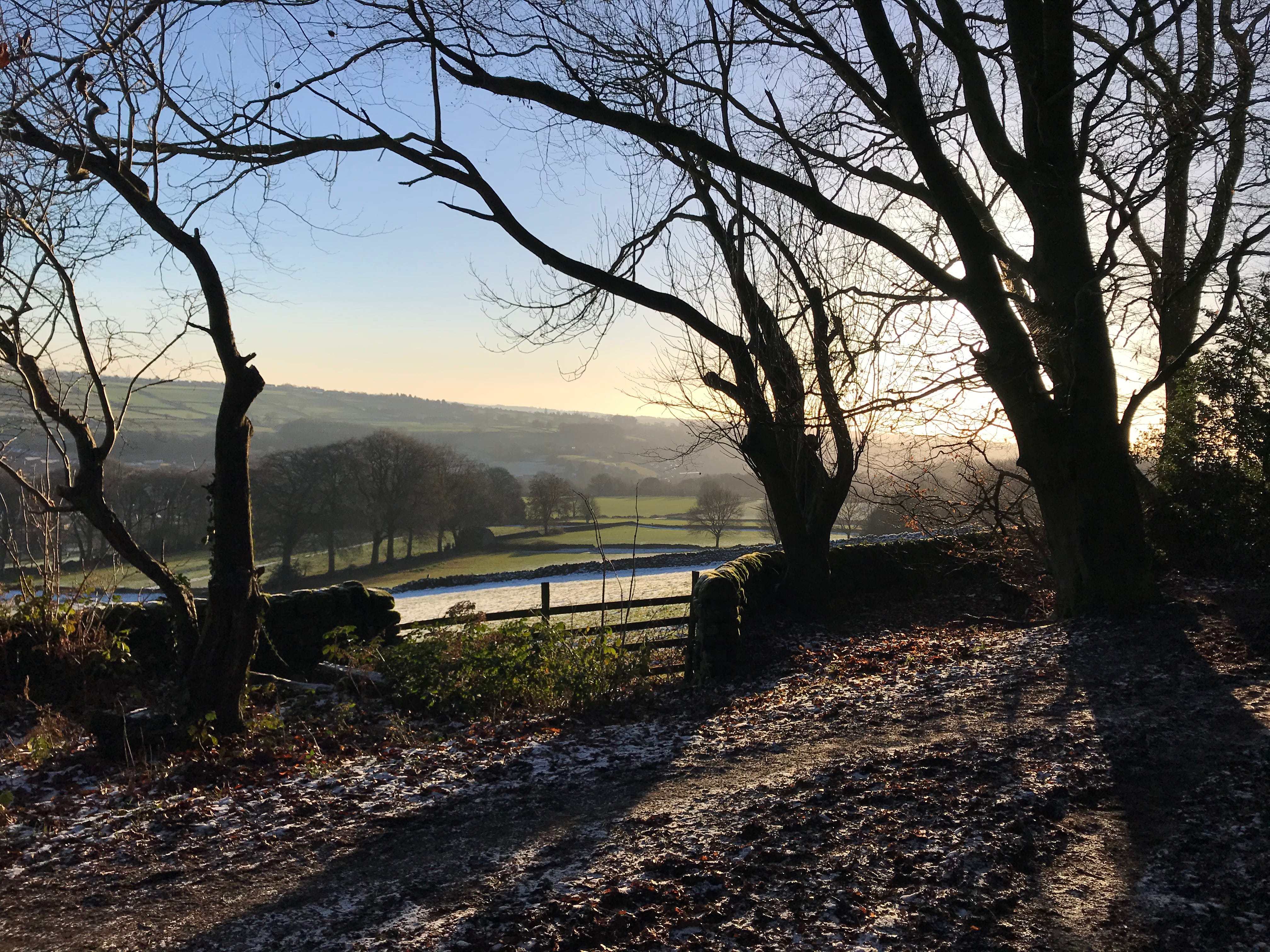
I set out between moonset and sunrise when Venus was up, at her brightest. Apart from her shining presence it was full dark. The thin whine from the cars of early-risers driving along the A6 paled next to the full-bodied shrieks of tawny owls that rose from each fragment of woodland I passed; my heart was set pounding as I gazed up at the ancient glitter of Venus, listening to their cries. After an hour or so of walking—ten minutes of fearful walk-trotting as a torchlight followed behind in the dark—I ascended up a holloway named Longwalls Lane that was once a medieval drovers’ road. Venus was still glimmering, though dawn was beginning to lay her up for the day.
I was looking for hares, and spotted the unmistakable hunch of one in the field next to the holloway. Hares seem to have an uncanny ability to know when they are being watched, and my settling gaze compelled it to flit, a rocking lumber to the field’s edge. Coming upon a hare takes me back to the memory of my first ever hare-sighting. People I have asked often vividly remember their encounters with hares, and I am no exception. I was in a strange space between my childhood and my late-twenties when I was at my most distant from the natural world. Driving through a dark Cumbria night with some friends, a hare jinked across the road in front of the car—in a way I now know is characteristic of the animal—and away into the verge. Something about the encounter went to my core; my fingers had lightly brushed a mystery and the feelings stirred in that brief moment still linger. At that time, The God Delusion and similar popular science books were on everybody’s bedside tables. Many young adults declared themselves proudly atheist and any sniff of believing in something supernatural, mysterious and beyond the material was ridiculed. I was briefly swayed, turning on the feelings invoked in me and the intangible presences I felt out in the natural world, which I wasn’t spending much time in anyway. But, like a glimpse of Faerie through the woods at twilight, I had seen a mystery, and I was touched with a powerful and enduring sense of wonder for hares that night, an ember that burned slowly through all the years I concerned myself with the trivia of early adulthood. That night was one of those that stood apart – star-bright and hare-rare.
Many years later, another charmed encounter marked the beginning of many meetings with hares. It was almost-night. An air of peace hung in the still October air that was cold and full of the approaching winter. In a field next to a footpath a hare reposed silently underneath a low, perfect crescent moon; the shoulders and ears were visible as silhouette, and an at-ease bearing told me he or she was relaxed – just resting in the moonlight. This encounter was followed by many more in the Old Frith in the succeeding months. I have got within a hair-breadth of hares on both Longwalls Lane and Courthouse Road. They have exploded from under my feet near Johnson’s Carr and Top Lane. I have watched them from the Chevin on spring mornings and lounging flaneur-like in fields near Shining Cliff woods. Seen barely-there hare silhouettes in the almost-gone light of summer evenings. Near Hazelwood, a leveret walked into my path, before turning aside and crouching in plain view, as if in its form. Here too I have seen fully-grown hares in the golden barley-stubble; and I have hidden a dead hare with no sign of injury deep in a verge of late-summer grass, only for the body to disappear a week later. Each one of these encounters has brought me up short.
Why do hare-meetings go straight to the heart for many? In The Leaping Hare George Ewart Evans and David Thomson explore the idea that our special relationship with the hare stems from a deep connection with them. That they are of the order of animals ‘associated with [us] in the long process of evolution’ that cause man to anthropomorphise the hare and ‘project on to it some of the qualities he is dimly aware of in himself.’ They theorise that our connection to the hare may be the tug of a deep-rooted ‘racial memory’ that lies buried beneath our modern rationalism and into which we have flashes of insight. This, the authors say, may explain why so many similar hare myths exist in the world’s different major cultures. They suggest that the ‘religious beliefs of [our] very remote ancestors’ play a role in how we meet hares today; that the hare’s natural allure and mystery for us is comparable to the ‘natural repugnance in Britain to eating horse-flesh’, which comes from our centuries-long horse reverence. In short, some animals, the hare included, hold an elevated position in our subconscious that has its origin in the thinking of our cave-dwelling ancestors.
Have some of the animals that held great significance for our ancestors left a long-lasting imprint on our memories? Are the creatures that we once held sacred—with rituals surrounding them that signified more than our hunting relationship with them—tied up so strongly with our spirituality that we cannot forget their part of it? This is what Thomson and Ewart Evans suggest, and I welcome the idea of this slender thread through time linking my mind to a people deeply embedded in the natural world – however faint tremors of memory travel down it. My dreaming has dulled in recent years. As a child I had vivid, colourful, involved and sometimes lucid dreams, often about animals. I still do sometimes, but often my dreams are mundane or frustrating, about being late or trying to dial a phone number over and over. Often they are unremembered entirely. But I have had some significant and radiant hare-dreams after encounters with them on walks: a sharp tug on the thread of some some deep well of hare-memory perhaps?
Revered or no, hares have long been hunted by us; and as the authors document in the The Leaping Hare, the hare has long hunted us back, stalking our subconscious and birthing manifold and prevalent superstitions in Britain. Even as quarry they have been lifted above some of their fellow creatures historically. In medieval forest lore they had elevated status as principal ‘beasts of the warren’, which was game that the local lords of the manor were able to hunt on their manorial lands and off-limits to the tenant forest-dwellers. In the Book of St Albans the ‘four beasts of venery’ are listed as hart, hare, wolf and boar: the respectable and proper animals for the nobility to hunt on horseback; the hare is conspicuous on that list as being neither as big nor as powerful as the other three animals.
There are many who do not revere the hare. Hare numbers have plummeted, it is estimated by around 80%, in the last hundred years. While hare coursing is illegal, hares are not protected by law and can be shot at any time of year. In Thomas More’s Utopia, he said this of coursing: ‘Thou shouldst rather be moved with pity to see a silly innocent hare murdered of a dog, the weak of the stronger, the fearful of the fierce, the innocent of the cruel and unmerciful. Therefore, all this exercise of hunting is a thing unworthy to be used of free men.’ I’m with More on that one, but I would never call a hare silly (although the meaning of ‘silly’ has changed since he scratched out his philosophies with a feather). He had seventy-seven alternative names to chose from, according to a Middle English poem ‘The Names of a Hare’. He could have plumped for:
The stubble-stag, the long lugs,
the stook-deer, the frisky legs,
the wild one, the skipper,
the hug-the-ground, the lurker,
the race-the-wind, the skiver,
the shag-the-hare, the hedge-squatter,
the dew-hammer, the dew-hopper,
the sit-tight, the grass-bounder,
the jig-foot, the earth-sitter,
the light-foot, the fern-sitter,
the kail-stag, the herb-cropper.
This anonymous poet knew the otherworldly power of hares, and the poem begins with a warning to those who meet one (the evil met), advising them to drop everything they are carrying and bless themselves with their elbow(!) and say a prayer in worship of the hare. What fate might befall those who didn’t, I cannot know; but any encounter with a witchcat or a faith-breaker or a scare-the-man was presumably not benign. I hope, in spite of all those unworthies out there who dare to harm the hare, that this name-changer, shape-shifter, ‘the pintail, the ring-the-hill, the sudden-start, the shake-the-heart,’ will long rule the fields. A sit-tight in our imaginations, where they have been running for a very long time.
The dew-hammer, what a brilliant and evocative name for one of the most mysterious inhabitants of the British Isles.